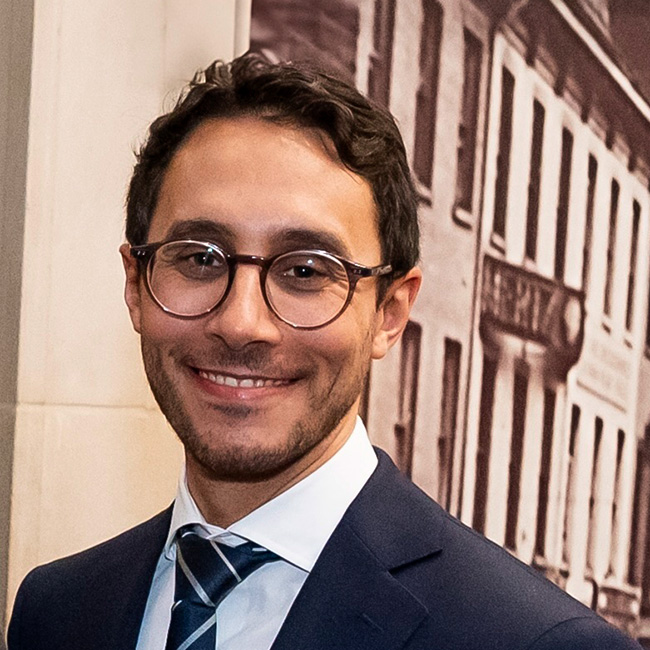
Dr. Neil J. Saad Duque is a Contributing Scholar at the Johns Hopkins Center for Health Security. His work focuses on strengthening the global health security architecture, surveillance system development, public health intelligence, and pandemic preparedness and response.
He holds a PhD in Epidemiology and Master of Public Health from Imperial College London, with undergraduate and graduate degrees in bioengineering. He completed postdoctoral training in infectious disease modelling at the Yale School of Public Health, where he was a Francqui Foundation Fellow. Recognizing that health security challenges increasingly intersect with conflict and complex emergencies, he also completed a Master of Advanced Studies in International Law in Armed Conflict from the University of Geneva. He is was a European Programme for Intervention Epidemiology Training (EPIET) Fellow at the Robert Koch Institute in Berlin, the European equivalent of the CDC's Epidemic Intelligence Service, and is an alumnae of the Emerging Leaders in Biosecurity (ELBI) Fellowship.
Dr. Saad Duque most recently served as Senior Programme Manager for Global Health Security at Gavi, the Vaccine Alliance, where he led cross-functional teams on outbreak response, including serving as incident manager for the global mpox response. He previously served as a Team Lead at the World Health Organization, leading a team on global health emergency detection of global health threats. He also worked at the United Nations Relief and Works Agency for Palestine Refugees in the Near East (UNRWA), where he led COVID-19 surveillance and response coordination. He has extensive field experience in humanitarian crises and conflict settings across Asia, Africa, and the Middle East with Médecins Sans Frontières, including during the 2018-2020 Ebola outbreak in the Democratic Republic of the Congo, mass displacement of Rohingya refugees in Bangladesh, in conflict-affected Syria, and in Cambodia.
His combination of rigorous field epidemiology, biosecurity expertise, and understanding of the legal frameworks governing health in conflict positions him to bridge academic research with the operational realities of health emergencies in resource-constrained and complex settings.